 How-to
Is It Worth Repairing Old Washing Machine? 2026 Guide
Last Updated: October 23, 2026
Quick Summary
Repairing old washing machine is usually worth it if the machine is under 10 years old and the repair cost is a reasonable percentage of a new machine's price. Over 12 years old, replacement often makes more financial sense due to higher breakdown risk and energy savings from modern machines.
- Most washing machines last 7-12 years with normal use; after 12 years, breakdowns become more frequent and expensive.
- Drum repairs can cost $650-$1,400, often close to replacement price on older machines.
- If your machine has had three or more repairs in two years, replacement usually makes sense.
- Modern machines can reduce water consumption by up to 50% compared to older models.
- Get a written repair quote before deciding; compare parts cost, labour, and warranty coverage against replacement price.
Table of Contents
- Is It Worth Repairing Your Old Washing Machine? The Key Decision Factors
- Washing Machine Repair Cost: What You'll Actually Pay
- Washing Machine Lifespan: How Long Should Yours Last?
- Common Washing Machine Problems and Repair vs Replace
- The 50% Rule and Total Cost of Ownership
- Signs You Need a New Washing Machine
- Energy Efficiency and Long-Term Savings
- Repair vs Replace: Your Decision Framework
- Frequently Asked Questions
Is It Worth Repairing Your Old Washing Machine? The Key Decision Factors
Deciding whether to repair or replace your washing machine comes down to three things: age, repair cost, and the price of a new one.
At ISB Electrical, we've helped Gold Coast families answer this question over 30 years in appliance repair.
This guide shows you how to calculate whether repairing old washing machine is the smart move.
Washing Machine Repair Cost: What You'll Actually Pay
The cost of repairing a washing machine varies wildly depending on what's broken, a seal replacement costs far less than a drum failure.
The table below shows typical repair cost ranges for common faults.
| Fault | Typical parts cost (AUD) | Typical labour (AUD) | Typical total (AUD) | Notes |
|---|---|---|---|---|
| Door seal or gasket | $40-$120 | $80-$150 | $120-$270 | Straightforward; often a DIY candidate |
| Drain pump | $60-$150 | $80-$160 | $140-$310 | Access varies by model |
| Inlet valve | $40-$100 | $80-$140 | $120-$240 | Usually quick |
| Drive belt | $30-$80 | $80-$140 | $110-$220 | Simple on many top-loaders |
| Motor brushes or motor | $150-$450 | $150-$300 | $300-$750 | Motor replacement is major |
| Bearings | $80-$200 | $250-$450 | $330-$650 | Labour-intensive; drum often removed |
| Control board | $200-$600 | $100-$200 | $300-$800 | Price varies hugely by brand |
| Drum assembly | $400-$900 | $250-$500 | $650-$1,400 | Often uneconomic on older machines |
A new washing machine varies in cost depending on brand, capacity and features.
Your repair quote should state exactly what's faulty and what it will cost to fix.
DIY versus professional repair
Some faults are DIY-friendly if you're comfortable with basic tools and have isolated the power and water: door seals, drain pumps and drive belts are common first jobs.
Before calling anyone, do the free checks: confirm the machine is level, clean the filter, check the drain hose for kinks, and make sure the door latch engages. If those don't solve it, a professional diagnosis is usually worth the call-out fee, often credited against the repair.
Washing Machine Lifespan: How Long Should Yours Last?
Most washing machines last 7-12 years with normal use, and some reach 15 if well maintained. After that, breakdowns become more frequent and expensive.
Age tells you how much useful life remains: a 3-year-old machine has many years ahead; a 14-year-old is near the end of its lifespan.
Your washing machine's expected lifespan depends on:
- Brand and build quality
- How often you use it
- Water hardness in your area
- Whether you perform regular maintenance
A machine that's already had several repairs is a warning sign. If repairing old washing machine has meant fixes three times in two years, another breakdown is likely soon.
Common Washing Machine Problems and Repair vs Replace
Different faults carry different weight in the repair-versus-replace decision: some are cheap and simple; others signal the machine is finished, or unsafe.
Faults that mean stop using the machine now
Some symptoms are safety signals, not cost questions. Stop using the machine and arrange a technician if you see or smell any of the following:
- Burning smell or smoke during a cycle
- Sparking, tripping circuit breakers, or a tingling sensation when touching the machine
- Water pooling near the power cord or motor area
- Exposed or damaged wiring
These faults can indicate electrical failure, bearing collapse or structural damage; continuing to use the machine risks fire, flooding or injury. Safety comes first.
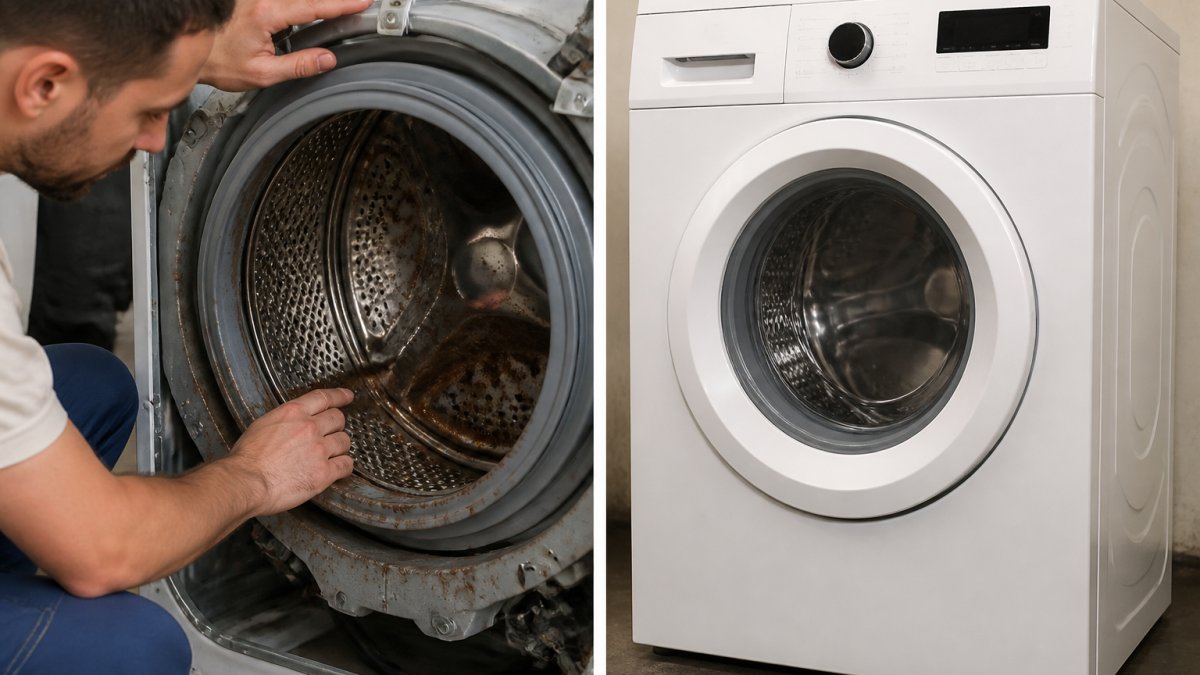
Drum failure
A faulty drum is one of the most expensive repairs: water leaks, clothes don't clean properly, or the machine won't spin.
Drum failure typically means rust damage or bearing wear. Both require removing and replacing the entire drum assembly, labour-intensive work with expensive parts.
If your machine is under 8 years old and the drum fails, repair makes sense, it has years of life left. If it's over 12 years old, a new machine is usually the better choice, since drum failure often signals other components are wearing out too.
Motor issues
The motor drives the drum and pump; when it fails, the machine won't spin or fill properly.
Motor replacement is moderately expensive, but motor failures don't always mean the machine is finished. Younger machines are usually worth repairing; older ones depend on what else might be failing.
Ask your technician whether it's an isolated problem or there are other signs of wear.
Leaks and seal problems
Leaks usually come from worn seals or gaskets, inexpensive, straightforward parts to replace.
A leaking washing machine is annoying but fixable. Unless the leak stems from a cracked drum or broken pump, seal replacement costs far less than a new machine.
Repairability, parts availability and warranty
Two machines with the same fault can have very different repair economics. Before deciding, check:
- Parts availability: Is the part in stock locally, or is it a special order with a long lead time? Obsolete or discontinued parts can make a cheap repair uneconomic.
- Brand support: Some brands keep spare parts available for many years; others discontinue them quickly. Ask the technician whether the part is still manufactured.
- Repair warranty: A repair backed by a warranty on parts and labour changes the risk calculation. A repair with no warranty is a bigger gamble on an old machine.
- Sealed or integrated assemblies: Some modern machines bundle parts into sealed units, so a small failure requires replacing a large, expensive module. This pushes the repair cost up and the replacement case forward.
Available parts and a warranty make a machine a stronger repair candidate even at a higher percentage of replacement cost; scarce parts and no warranty weaken it even if the quote looks low.
The 50% Rule and Total Cost of Ownership
You've probably heard the 50% rule: if the repair cost exceeds a certain percentage of a new machine's price, replace it. It's a useful starting point, but not the whole story.
If a new machine costs a certain amount and the repair quote is a significant percentage of that, consider replacement.
Total cost of ownership includes more than just the repair or replacement price:
- Energy consumption (older machines use more water and power)
- Water usage (an inefficient machine wastes money every cycle)
- Risk of future breakdowns (older machines fail more often)
- Warranty coverage (new machines come with guarantees; repairs do not)
A new, efficient machine might cost more upfront but save money over 10 years through lower energy bills. An old machine that's been repaired might work another 2 years, then fail again, a risk to factor in.
Signs You Need a New Washing Machine
Certain warning signs suggest replacement is the smarter choice:
- The machine is over 12 years old
- It's had three or more repairs in the past two years
- The repair cost exceeds a significant percentage of a new machine's price
- The drum is rusted or cracked
- The motor won't engage or the pump won't prime
If your washing machine shows multiple warning signs, replacement usually makes sense. One repair doesn't mean the machine is finished. Two repairs in quick succession? That's a pattern worth taking seriously.
A machine that's reliable one month and broken the next costs stress and time, not just money.
Energy Efficiency and Long-Term Savings
Older washing machines are energy hogs. A machine from 2010 uses significantly more water and electricity than a modern model.
Modern machines use less water per cycle, heat water more efficiently, and spin clothes drier, cutting drying time and energy.
If your old washing machine still works but is ageing, consider the long-term cost.
The maths can work in favour of replacement, especially if you use your washing machine frequently.
Repair vs Replace: Your Decision Framework
Use this framework to make your decision. Answer each question honestly.
Step 1: How old is your machine?
- Under 7 years: Repair is usually the right choice
- 7-10 years: Repair if the cost is reasonable
- 10-12 years: Repair only if the cost is low
- Over 12 years: Replace unless the repair is very cheap and it's an isolated problem
Step 2: What's the repair cost?
Get a written quote. Compare it to the price of a new machine. Use the percentage thresholds above.
Step 3: What's the repair history?
- First repair: Lean toward repair
- Second repair in 2 years: Consider replacement
- Third repair or more: Replace
Step 4: What's broken?
- Simple parts (seals, gaskets, pumps): Repair
- Major components (drum, motor): Consider age and cost
- Control board: Get the quote before deciding
Step 5: What's your risk tolerance?
If you need reliability, replacement gives peace of mind.
Base your decision on age, cost and repair history, not emotion.
Deciding whether repairing your old washing machine is worth it comes down to age, repair cost and future-breakdown risk.
ISB Electrical can help you decide.
Frequently Asked Questions
What is the 50% rule for repairing appliances like washing machines?
The 50% rule suggests that if the repair cost exceeds a certain percentage of the price of a new washing machine, replacement is usually the better choice. This rule accounts for the risk of further breakdowns in an older machine and the warranty protection of a new appliance.
Is it worth fixing a 5-year-old washing machine?
At five years old, most washing machines are still within their reliable operating window. A single repair is usually worth pursuing, especially if the machine has no prior repair history. However, check the repair cost against replacement price and consider energy efficiency gains from a newer model. If the repair is straightforward (like a seal replacement) and costs a reasonable percentage of a new machine, repair is typically the sensible choice. Multiple recent repairs signal it may be time to replace.
How long should a washing machine last before I need to replace it?
Most washing machines last 7 to 12 years with proper maintenance. Machines reaching 10 years old are entering a higher-risk period for costly failures. Beyond 12 years, parts become harder to source and repair costs rise significantly. If your machine is older than 10 years and needs a major repair (drum, motor, or pump), replacement often makes better financial sense than investing in parts that may fail again soon.
What washing machine problems are usually worth repairing versus replacing?
Simple repairs like replacing hoses, seals, or pump filters are almost always worth fixing, even on older machines. Drum failures and motor problems are expensive and often signal it's time to replace. Leaks caught early (usually seal or hose issues) are repairable. If your machine is under 8 years old and the repair is reasonably priced, repair is typically worthwhile. Machines over 10 years old with expensive component failures (drum, motor) are better replaced, as future breakdowns become more likely.