 blog
Are Washing Machine Repair Services Worth It?
Quick Summary
A good washing machine repair service is defined by a qualified technician, a clear diagnosis before any work starts, and genuine parts with a written warranty. Before booking, ask whether the technician is qualified, insured, and able to explain the fault and quote upfront.
- Check that the technician is qualified for appliance repair and carries public liability insurance.
- Ask the provider to explain the fault before quoting any repair.
- Confirm that genuine spare parts are used and what the parts warranty covers.
- Ask whether the call-out fee is stated upfront and whether it is credited against the repair.
- Ask whether the quote is fixed or an estimate, and approve any extra faults before work continues.
Table of Contents
- What Separates a Good Washing Machine Repair Service
- Common Washing Machine Faults and What They Usually Cost to Fix
- Is Repair or Replacement the Better Choice for Your Machine
- How Same-Day Washing Machine Repair Works and What to Expect
- Washing Machine Repair Warranties and Genuine Parts Explained
- Checking Licences, Insurance and Technician Credentials
- Booking Your Washing Machine Repair With ISB Electrical
- Frequently Asked Questions
What Separates a Good Washing Machine Repair Service
A good washing machine repair service is defined by three things: a qualified technician, a clear diagnosis before any work starts, and genuine parts with a written warranty. ISB Electrical, a family-owned Gold Coast business led by a qualified Electrical Engineer with over 30 years of experience, is built around those three points.
Most people looking for the best washing machine repair services on the Gold Coast want the same thing: a machine that works again without a second visit. Some services can deliver that. Others leave you waiting, quoting vaguely, or fitting cheap parts that fail within weeks.
The first thing to check is who actually attends. Ask whether the technician is qualified to work on the appliance and carries public liability insurance. A clear answer to these questions can tell you more than any advertising does.
Here is a short checklist to use when comparing providers:
- Is the technician qualified for appliance repair, and can they show it?
- Do they explain the fault before quoting a repair?
- Do they use genuine spare parts, and is there a warranty on those parts?
- Is the call-out fee stated upfront?
- Can they give a realistic arrival window?
Another mark of quality is how a service handles diagnosis. A good technician tests the machine, explains what is wrong, and gives you the option to decline the repair. A poor one tends to push replacement straight away.
It is sensible to ask for these details before booking any provider. If a provider cannot answer them plainly, keep looking.
Common Washing Machine Faults and What They Usually Cost to Fix
Most washing machine breakdowns fall into a handful of categories. Knowing the usual faults helps you judge whether a quote is reasonable. Actual costs depend on the machine's make, model, age and the parts required, so ask for a written quote for your specific machine.
The most common faults include:
- Not draining: often a blocked pump filter or a failed drain pump.
- Leaking water: commonly a worn door seal, a loose hose or a faulty inlet valve.
- Not spinning: frequently a drive belt, motor or lid switch issue.
- Door lock faults: the door will not open or close properly.
- Error codes: these point to a specific sensor or board fault and need proper diagnosis.
Diagnosis and repair time can vary between simple mechanical faults and electronic faults, and a written quote will reflect the specific machine.
Ask any provider about its call-out or diagnostic fee and how parts are charged before booking, so the final invoice holds no surprises.
Watch out: a machine that leaks from the base is not always a seal problem. Water can come from the inlet hose or the drain pump, and replacing the wrong part wastes money. Ask the technician to confirm the source first, and ask whether any diagnostic fee is credited against the repair if you go ahead.
The article lists the most common washing machine faults and the usual causes behind them:
| Fault | Common cause | Note |
|---|---|---|
| Not draining | Blocked pump filter or failed drain pump | Often a simple fix |
| Leaking water | Worn door seal, loose hose or faulty inlet valve | Confirm the source first |
| Not spinning | Drive belt, motor or lid switch issue | Ask for a diagnosis |
| Door lock faults | Door will not open or close properly | Check the lock mechanism |
| Error codes | Specific sensor or board fault | Needs proper diagnosis |
Is Repair or Replacement the Better Choice for Your Machine
This is the question many homeowners find hardest. The honest answer depends on the age of the machine, the cost of the repair compared with replacement, and how reliable the machine has been up to now. A simple framework makes the decision clearer than a gut feel.
Work through these four questions in order:
- How old is the machine? A repair is generally easier to justify earlier in a machine's expected service life than near its end. If the machine is already well into its expected lifespan, a repair buys less future use per dollar.
- What is the repair cost as a share of a new machine? As a general guide, a repair that costs little compared with a comparable new machine is often worth doing, while a repair approaching the price of a new machine often is not, especially on an older unit. Compare like with like: the same size, type and feature set.
- Is it one fault or several? A single isolated fault on an otherwise reliable machine points to repair. Multiple faults, or a fault that has returned after a previous repair, point to replacement because the underlying reliability has gone.
- How reliable has it been? A machine that has needed repeated call-outs is likely to keep needing them. A machine that has run for years without trouble is usually worth one more repair.
A worked example shows how the framework behaves. A mid-life front loader with a single isolated fault may be worth repairing, while an older machine with several faults and an expensive part may be better replaced.
Ask the technician to explain both options in those terms: the fault, the repair cost, the age of the machine and what a comparable replacement would cost. A trustworthy service will tell you when a repair is not worth doing, even when that means less work for them.
Watch out: a quote that only covers the visible fault can grow once the machine is opened up. Ask whether the quote is fixed or an estimate, and whether any additional faults found during the repair will be quoted for approval before work continues.
If you are weighing the decision, our guide on whether repairing an old washing machine is worth it covers the factors in more detail.
How Same-Day Washing Machine Repair Works and What to Expect
Same-day repair means a technician attends and, where possible, completes the repair on the same day you book. It is most useful when a machine has stopped working with a full load of laundry or when you are without a machine for a family.
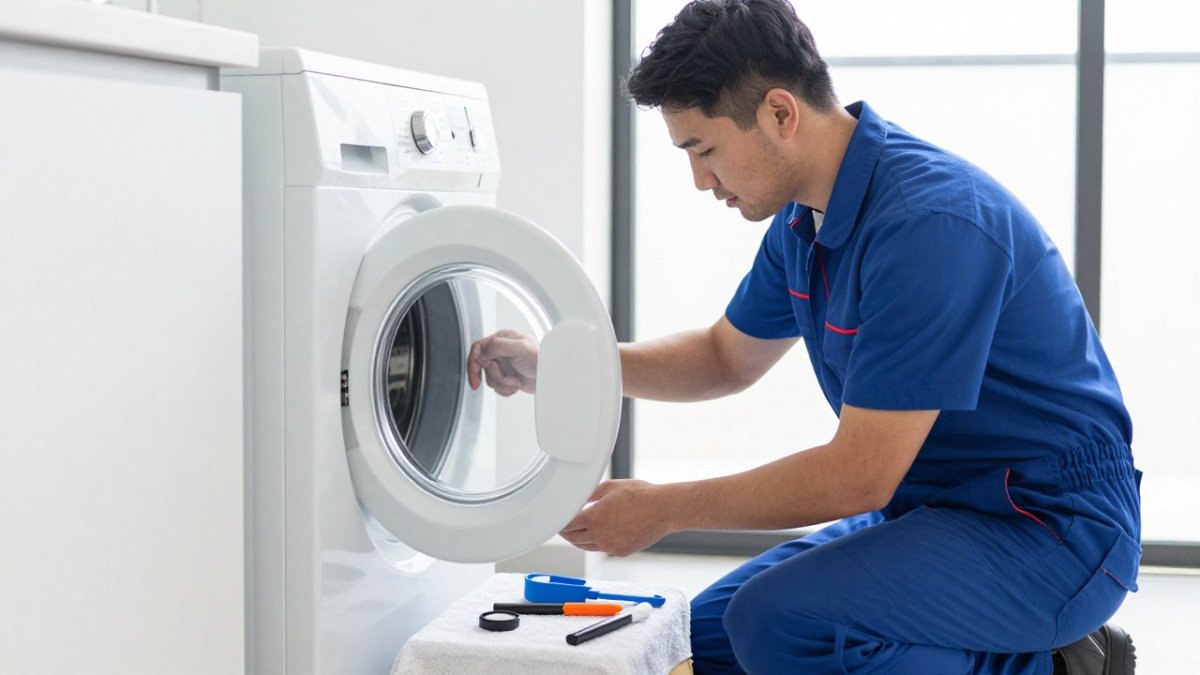
The process usually runs in four stages:
- Booking: you describe the fault, including any error code and when it started.
- Arrival and diagnosis: the technician checks the machine and identifies the problem.
- Quote and approval: you receive a clear explanation and the cost before work starts.
- Repair and testing: the technician fixes the fault and runs the machine to confirm it works.
Same-day availability depends on the job and the time you call, so confirm the expected arrival window when you book.
Preparing Your Machine and Your Home Before the Technician Arrives
A little preparation saves time. Clear the area around the machine so the technician can reach the back and underneath. Remove any wet laundry and make sure the power point is accessible.
It also helps to write down the error code shown on the display, the date the fault started, and any recent changes, such as a new detergent or a power cut. Keep the machine's model number handy, usually found on a label inside the door or on the back panel.
Washing Machine Repair Warranties and Genuine Parts Explained
Parts quality affects how long a repair lasts. Genuine spare parts are made to the manufacturer's specification and usually fit and perform as designed. Cheaper non-genuine parts can be a false economy if they fail early and cause the same fault again.
ISB Electrical uses genuine spare parts and offers a warranty on the spare parts used. For more on whether these parts justify their cost, read our guide to genuine spare parts. Ask any provider to confirm in writing what the warranty covers, how long it lasts and whether it includes labour.
Ask also whether the repair itself is guaranteed. A warranty on parts and a guarantee on workmanship are different things, and both are worth understanding before you book.
Checking Licences, Insurance and Technician Credentials
Before a technician works on your appliance, it is reasonable to ask for proof of their qualifications and insurance. A qualified technician should be able to show their credentials, and a reputable business should be able to confirm that it carries public liability insurance.
This matters if something goes wrong during the repair. Insurance protects you if damage occurs at your property. You can verify the basics by asking for the business name, the technician's name and their qualification details, then checking that the business is registered.
ISB Electrical's technicians are licensed and insured, and the business is led by a qualified Electrical Engineer. Questions about credentials can be raised before any work begins.
Booking Your Washing Machine Repair With ISB Electrical
If your machine has stopped working, booking early gives you the best chance of a same-day visit. Call us with the make and model, the fault or error code, and your suburb, and we will confirm availability and the next steps. You can also read about washing machine repairs in Elanora and the faults we cover there.
ISB Electrical services the Gold Coast, including Ormeau, Pimpama and Burleigh. For current pricing, visit our website or contact us for a quote.
Repairing a washing machine with a qualified team, genuine parts and a warranty can help keep your laundry running. Get in touch with ISB Electrical today and let our technicians diagnose the problem and get your machine working again.
Frequently Asked Questions
How do I choose a reliable washing machine repair service?
Look for a technician who is licensed and holds current public liability insurance, and ask whether they use genuine parts. Check what warranty the business offers in writing, and ask about any call-out or diagnostic fee before booking. A named, qualified technician is easier to hold accountable than an anonymous call centre. Reviews help, but ask the business directly how it handles a repair that does not hold.
How much does washing machine repair usually cost?
Costs depend on the fault, the machine's brand and model, and how quickly you need the work done. Diagnostic or call-out fees are usually charged separately and may be credited against the repair if you go ahead. Pricing varies by quantity of parts and whether a same-day visit is required, so the most reliable figure is a written quote. Contact ISB Electrical through its website for current pricing and a quote for your specific machine.
Is it worth repairing a washing machine or should I replace it?
Repair is often the better option when the machine is relatively young, the fault is a single component, and the repair cost is well below the price of an equivalent new machine. Replacement makes more sense when the drum, bearings or main control board have failed on an older machine. A reputable technician should explain both options honestly and give you a clear figure for each.
Do washing machine repair services offer a warranty?
Most reputable services warrant the parts they fit and the workmanship for a stated period. ISB Electrical provides a warranty on all spare parts used, and only genuine spare parts are fitted. Ask for the warranty terms in writing before the work starts, including what is covered, for how long, and what happens if the same fault returns.