 blog
Dishwasher Repair Cost: What to Expect in 2026
Last Updated: October 23, 2026
Quick Summary
Dishwasher repair cost typically ranges from $110 to $780 depending on the fault, with simple repairs like filter replacements costing $110-$220 and complex issues like control board failures reaching $400-$780. The final dishwasher repair cost is driven primarily by which component has failed, your machine's brand and age, labour time required, and your location.
- Drain pump faults cost $220-$420, while inlet valve issues run $160-$300 and control board failures reach $400-$780
- Call-out fees vary by region and technician; many reduce or waive the fee if you proceed with repairs
- Repair makes sense for machines under eight years old where the quote is well under half the replacement cost
- Genuine parts cost more than aftermarket but carry manufacturer backing for critical components like pumps and boards
- Labour typically ranges from 30 minutes for simple repairs to two to three hours for complex jobs like pump removal
Table of Contents
- What Affects Dishwasher Repair Cost
- Understanding Dishwasher Repair Call-Out Fees
- Labour Charges and Dishwasher Repair Time
- Dishwasher Parts Replacement Cost Breakdown
- Dishwasher Repair or Replacement: Making the Decision
- How to Get an Accurate Repair Quote
- Frequently Asked Questions
What Affects Dishwasher Repair Cost
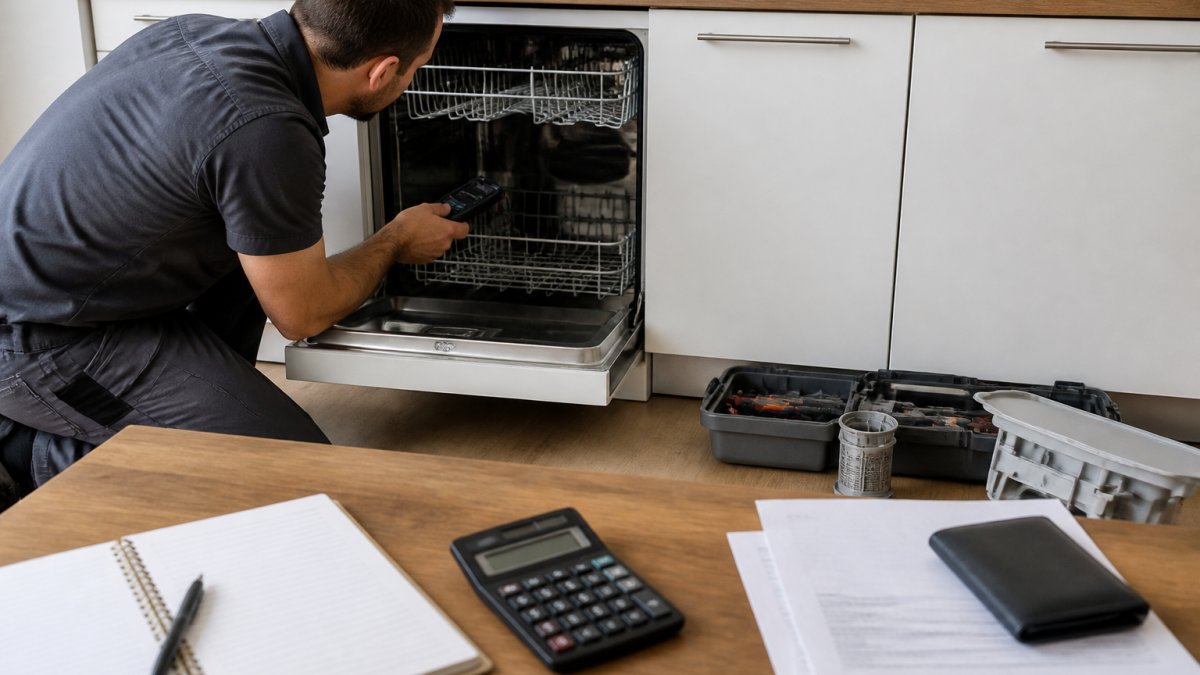
A licensed appliance technician in work uniform diagnosing the interior of an open dishwasher, holding a diagnostic tool, with spare parts visible on a workbench nearby.
The cost to repair a dishwasher depends on several factors that interact to determine your final bill.
The type of fault is the primary cost driver. A drainage problem that requires pump replacement costs significantly more than a simple inlet valve issue.
The age of your dishwasher influences both parts availability and repair viability. Older models may require harder-to-source components, pushing costs up. Newer machines often have more expensive electronics.
Understanding Dishwasher Repair Call-Out Fees
A call-out fee is the charge simply for a technician to visit your home and diagnose the problem. This fee typically applies whether the repair proceeds or not. Many service providers structure their pricing so that if you go ahead with repairs, the call-out fee reduces or disappears from your final invoice.
Call-out fees vary by region and business model. Some technicians charge a flat diagnostic fee upfront, while others bundle diagnosis into the repair cost. The key is asking about this before booking, clarity on call-out fees prevents billing surprises.
Labour Charges and Dishwasher Repair Time
Labour costs depend on how long the repair takes. Most dishwasher repairs fall into a predictable timeframe. Simple repairs like replacing inlet valves or drain filters might take 45 minutes to an hour. Complex jobs involving control board replacement or pump removal can stretch to two to three hours.
Technicians typically charge hourly rates for labour, though some offer fixed-price repairs for common faults. Knowing the expected repair time helps you understand what you're paying for. A two-hour job naturally costs more than a 45-minute one, but both may be necessary depending on what's wrong.
The complexity of access matters too. Some dishwashers require extensive disassembly to reach faulty components. Others have design flaws that make repairs unnecessarily time-consuming. This directly affects how long a technician spends on site and therefore your labour bill.
Dishwasher Parts Replacement Cost Breakdown
A licensed appliance technician in work uniform diagnosing the interior of an open dishwasher, holding a diagnostic tool, with spare parts visible on a workbench nearby.
Most quotes you see online give a single broad range. See real examples of Miele dishwasher repairs with associated problems. That is not much help when you are trying to work out whether a quote for a drain pump is fair.
| Fault | Part usually replaced | Typical part cost (AUD, incl. GST) | Typical labour | Indicative total (AUD, incl. GST) |
|---|---|---|---|---|
| Won't drain / standing water | Drain pump | $80-$180 | 45-90 min | $220-$420 |
| Won't fill | Inlet valve | $40-$110 | 30-60 min | $160-$300 |
| Dishes won't dry / no heat | Heating element | $90-$220 | 60-120 min | $260-$480 |
| Poor wash / no spray | Circulation pump | $150-$320 | 90-150 min | $380-$650 |
| No response / error codes | Control board | $180-$450 | 60-120 min | $400-$780 |
| Leaks at door | Door seal | $30-$90 | 30-45 min | $130-$260 |
| Blocked spray arms / filter | Filter or spray arm | $20-$70 | 20-40 min | $110-$220 |
These ranges assume a standard call-out fee that is either absorbed into the repair or charged separately. View real examples of Fisher & Paykel dishwasher repairs with associated problems. Always confirm which applies before you book.
Why the same fault can cost twice as much
Three things move the number within each range:
- Brand tier. Premium European brands often use proprietary pumps and boards with limited aftermarket supply, so the part alone can sit at the top of the range. Budget and mid-tier machines usually have widely available components.
- Age and parts availability. A machine more than about ten years old may need a part that is no longer stocked locally, adding a wait and sometimes a special-order surcharge.
- Access. A freestanding unit can often be pulled out and worked on in minutes. A fully integrated built-in may need cabinetry panels removed and the unit disconnected from water and power before diagnosis even starts, adding labour time.
Genuine versus aftermarket parts
Genuine parts from the manufacturer typically cost more but carry manufacturer backing and are the safer choice for critical components such as pumps, heating elements and control boards. Aftermarket parts cost less and are usually fine for simple items such as seals, filters and spray arms. Ask your technician which category each quoted part falls into, a quote that does not distinguish between them is hard to compare against another.
Understanding appliance fault diagnosis guides help homeowners recognise common symptoms, though professional diagnosis remains essential for accurate repair quotes.
Dishwasher Repair or Replacement: Making the Decision
A practical framework beats a single rule of thumb. Work through the four tests below in order; the first one that gives a clear answer usually settles it.
Test 1: The 50 per cent rule, applied properly
Compare the quoted repair cost against the cost of a comparable new machine, not against what you originally paid. As a rough guide, if the repair quote is more than about half the price of a like-for-like replacement, replacement usually wins on economics. If it is well under half, repair is normally the better call.
Test 2: Age against expected service life
Most dishwashers are expected to last roughly eight to twelve years with normal use. Use that as a guide, not a hard line:
- Under about five years: repair is almost always the right choice unless the fault is a known design defect or the machine has been badly abused.
- Five to eight years: repair is usually still worthwhile for a single fault, but weigh it against the 50 per cent rule.
- Over about ten years: replacement becomes increasingly attractive, because a second failure is more likely and parts may be harder to source.
Test 3: Repair history and fault pattern
A single fault after years of reliable service is a strong signal to repair. Two or more major faults within a couple of years, especially involving pumps, boards or heating elements, is a pattern. Repeated repairs on the same machine tend to cost more over time than a single replacement, and each repair resets your exposure to the next failure.
Test 4: Warranty, running costs and the non-financial factors
- Warranty. If the machine is still under a manufacturer's warranty, check whether the fault is covered before authorising any paid work. A repair carried out under warranty may cost you nothing beyond inconvenience.
- Running costs. An older machine that is inefficient can cost more to run each year than the repair itself. Factor in likely energy and water use when comparing repair against a newer, more efficient model.
- Workmanship warranty. A reputable repair should come with a warranty on both the part and the labour. A repair backed by a solid workmanship warranty is worth more than a marginally cheaper one with none.
A worked example
Say a six-year-old mid-range machine needs a circulation pump. The repair is roughly half the replacement cost, the machine is within its expected service life, and this is its first major fault, so repair is the sensible choice. Now change one variable: the same quote on an eleven-year-old machine with two prior repairs. The repair is still around half the replacement cost, but age and history tip the decision toward replacement.
The brand and model influence this decision. Premium brands often justify repair costs because parts are reliable and machines hold value. Budget models might be more cost-effective to replace.
How to Get an Accurate Repair Quote
Getting an accurate quote requires providing technicians with specific information about your dishwasher and the fault. Start with the brand, model, and age. Note the exact fault code if your machine displays one.
Request quotes from multiple service providers. This gives you a sense of the market rate and helps identify outliers.
Ask whether the quote includes parts, labour, and call-out fees. A transparent quote breaks down each component so you understand what you're paying for.
Consumer rights for appliance repairs in Australia outlines your protections when engaging repair services. Understanding your rights helps you negotiate fairly and know what recourse you have if repairs fail prematurely.
At ISB Electrical, we provide transparent quotes that break down parts, labour, and any call-out fees upfront. Our licensed technicians diagnose faults accurately, which means our quotes reflect the actual work needed. We use genuine spare parts backed by warranty, so you know the repair will last. Same-day service availability means you're not waiting days for your machine to be fixed, we understand how essential dishwashers are to daily life.
Dishwasher repairs don't have to drain your budget. Understanding what drives costs, fault type, parts required, labour time, and your location, puts you in control of the decision.
Frequently Asked Questions
How much does it typically cost to repair a dishwasher?
Dishwasher repair cost varies significantly based on the fault, parts required, and labour involved. A simple diagnostic and minor repair might cost considerably less than replacing a major component like a pump or motor. Service call fees, labour time, and parts all factor into the final bill. For an accurate estimate tailored to your specific dishwasher and fault, contact a licensed repair technician who can assess the problem before quoting.
Do dishwashers have a typical life expectancy, and when should I consider replacing instead of repairing?
Most dishwashers last 7-10 years with proper maintenance. If your dishwasher is approaching or beyond this age and requires a costly repair, replacement may be more economical. Consider the repair cost relative to a new unit's price, warranty coverage, and energy efficiency improvements. A qualified technician can advise whether repair is worthwhile for your specific model and fault.
What is included in a dishwasher repair service call?
A typical service call includes a call-out fee, diagnostic inspection to identify the fault, and labour time for the repair. Some technicians offer fixed-price service options for common faults. Parts and labour are often quoted separately, and reputable providers use genuine spare parts backed by warranty. Always clarify what the quote covers before booking.
Is it worth repairing a 5-year-old dishwasher, or should I replace it?
A 5-year-old dishwasher is typically in the mid-range of its lifespan, so repair often makes financial sense if the fault is not catastrophic. Compare the repair cost to replacement; if repair costs less than half of a new unit's price, repair is usually the better choice. However, if multiple components are failing or the repair requires significant labour, replacement may offer better long-term value and improved energy efficiency.