 How-to
How to Find a Licensed Appliance Repairer in Australia
Last Updated: November 2, 2026
Quick Summary
To find a licensed appliance repairer in Australia, check their electrical licence on your state or territory regulator's official register, confirm the licence class matches the job, and verify their public liability and workers' compensation insurance. Repairs involving mains power, gas or water need a licensed repairer. Never book on a verbal assurance alone.
- Ask the technician for their full legal name, licence number, licence class and issuing state.
- Search the licence on the official register for your state or territory, such as SafeWork NSW or Energy Safe Victoria.
- Confirm the licence is active and not expired, suspended or cancelled before booking.
- Request a certificate of currency for public liability insurance and check it matches the business.
- Get the warranty and written quote in writing before any work starts.
Table of Contents
- Why Licensing Matters When Someone Works on Your Appliances
- Which Appliance Repairs Need a Licensed Electrician
- How to Check an Electrician's Licence Before Booking
- Step 1: Ask for the right details before the visit
- Step 2: Find the correct regulator for your location
- Step 3: Match the licence class to the work
- Step 4: Confirm the licence is current
- Step 5: Verify the business, not just the person
- Step 6: Check insurance separately
- What about gas work?
- A quick verification checklist
- Questions to Ask an Appliance Repairer Before You Book
- How to Compare an Appliance Repair Quote
- What a Repair Warranty Should Cover
- Warning Signs of an Unlicensed or Unsafe Repairer
- Booking a Licensed Repair With ISB Electrical
- Frequently Asked Questions
Why Licensing Matters When Someone Works on Your Appliances
A licensed appliance repairer has the qualifications and legal standing to work safely on your appliances. Licensed appliance repair matters most when mains power, gas or water is involved.
Many homeowners assume any repair person is equally qualified, but the work varies. A dishwasher drain swap is simple; rewiring an oven circuit is not.
Here is what to look for when weighing a repairer's credentials:
- Electrical licence: Confirms the person is qualified to work on fixed wiring and appliance connections.
- Public liability insurance: Covers damage the technician may cause to your property during the job.
- Workers' compensation cover: Protects you if a technician is injured while working in your home.
Which Appliance Repairs Need a Licensed Electrician
Not every appliance fault needs an electrician, but any repair involving power supply, hardwired connections or electrical controls inside a major appliance should be handled by a licensed electrician.
Repairs that generally require a licensed electrician include:
- Electric ovens and cooktops with faulty heating elements, wiring or thermostats
- Ceramic and induction cooktops that trip circuits or show electrical faults
- Dishwashers and dryers with damaged power cords, switches or control boards
Some faults are simple enough for a competent technician to fix without rewiring, such as replacing a door seal or worn drum belt.
If you are unsure whether your oven or cooktop fault needs a licensed electrician, our oven and cooktop repair service can assess it and advise you on the right next step.
How to Check an Electrician's Licence Before Booking
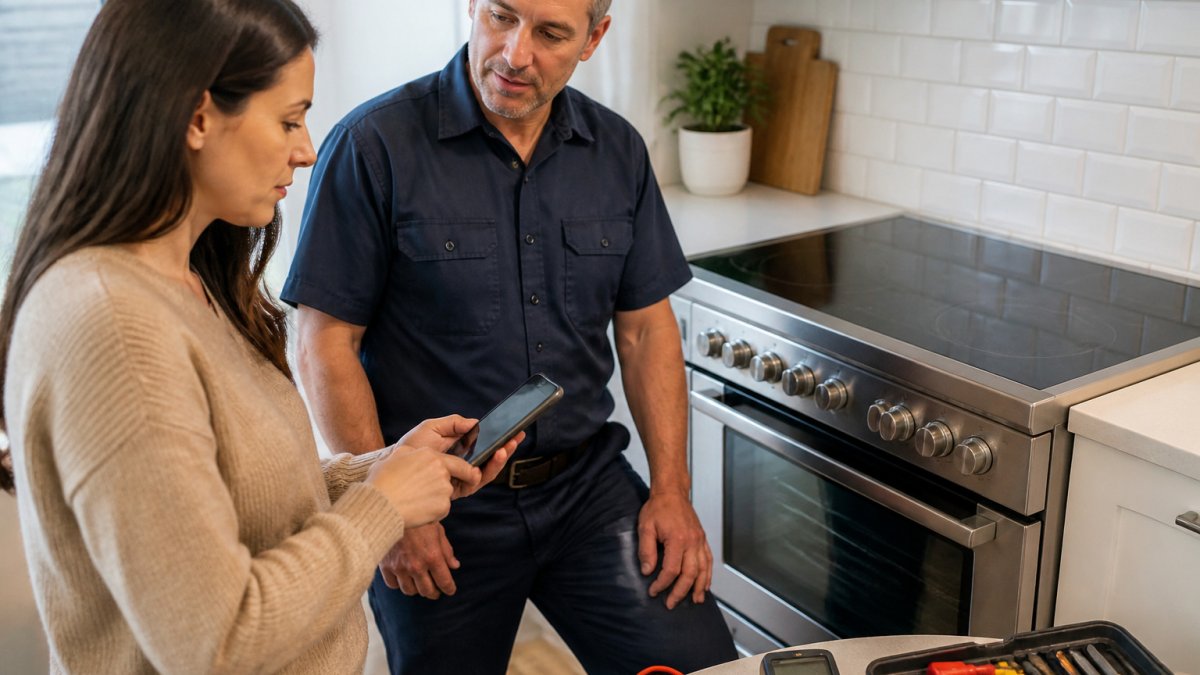
Checking a licence takes a few minutes and removes most of the risk of hiring someone unqualified. Verify it yourself against the official register rather than accepting a verbal assurance, business name or photo of a card.
Step 1: Ask for the right details before the visit
Ask the person who will physically attend for:
- Their full legal name (not just the trading name)
- Their licence number and licence class
- The state or territory that issued the licence
A legitimate technician will provide these without hesitation. If they deflect, that is your answer.
Step 2: Find the correct regulator for your location
Licensing is state and territory based, so the register you search depends on where the work is being done. The main regulators are:
- New South Wales: SafeWork NSW maintains the electrical licence register; you can search by licence number or name.
- Victoria: Energy Safe Victoria (ESV) publishes a public register of licensed electricians.
- Queensland: the Electrical Safety Office (ESO), part of WorkSafe Queensland, holds the register.
If the technician holds a licence from a different state, ask whether it is recognised in your jurisdiction, mutual recognition exists, but conditions vary.
Step 3: Match the licence class to the work
A licence number alone is not enough. Electrical licensing is tiered, and the class determines what work the holder can legally do. Typical distinctions include:
- Electrical worker (or equivalent): can perform electrical work under supervision or as defined by the class.
- Electrical contractor: the business entity licensed to contract for electrical work; the contractor licence is separate from the individual worker's licence.
- Restricted classes: may cover specific work types only (for example, some disconnect/reconnect or appliance work) and are not a substitute for a full licence on complex jobs.
Check that the class on the register matches the job. A restricted licence holder doing a full rewire is a red flag.
Step 4: Confirm the licence is current
A register entry can show a licence that has expired, been suspended or been cancelled. Look for:
- Status: active, suspended or cancelled
- Expiry date: confirm it has not lapsed
- Conditions: some licences carry conditions that limit the work permitted
If the register shows a status other than active, do not proceed.
Step 5: Verify the business, not just the person
A common mistake is accepting a business name in place of a personal licence. The person doing the work should hold the licence, and the business should hold the relevant contractor licence. Check both where the register allows it.
Step 6: Check insurance separately
Public liability insurance is not the same as a licence, and it is not always shown on the licensing register. Ask for a certificate of currency and confirm:
- The policy is current (check the dates)
- The insured entity matches the business you are hiring
- The cover limit is appropriate for residential work
Workers' compensation cover is a separate check. If the technician is injured in your home, you want to know they are covered.
What about gas work?
If the repair involves a gas appliance, a gas oven, cooktop or hot water system, a separate gas licence is required. Gas fitting is regulated separately from electrical work, and the relevant regulator varies by state (for example, Energy Safe Victoria for gas in Victoria, or the relevant technical regulator in your jurisdiction).
A quick verification checklist
| Check | What to confirm |
|---|---|
| Identity | Full legal name matches the register |
| Licence number | Searchable on the official state or territory register |
| Licence class | Matches the work being quoted |
| Status | Active, not suspended or cancelled |
| Expiry | Current date is before the expiry date |
| Contractor licence | Business holds the relevant contractor licence |
| Insurance | Certificate of currency is current and matches the business |
| Gas (if applicable) | Separate gas licence verified |
For a deeper walkthrough of the verification process, see the guide on how to verify licensed appliance technicians.
Verification is not a one-off. If the same business sends a different technician on a return visit, check that person's licence too. The licence belongs to the individual, not the van.
Questions to Ask an Appliance Repairer Before You Book
The right questions reveal how a repairer works before you commit any money. A reputable business will answer them clearly.
Useful questions include:
- Are the technicians who attend licensed, and can you provide their licence numbers?
- Are you insured for public liability and workers' compensation?
- Do you use genuine parts, and what warranty applies to them?
If a repairer avoids these questions or pressures you into a decision on the phone, treat that as a warning sign. Compare answers across two or three providers before choosing.
You can also compare providers' services directly.
How to Compare an Appliance Repair Quote
A repair quote should break down costs clearly. Most combine a call-out fee, labour and parts, and the total varies widely depending on the appliance and fault.
When comparing quotes, check these points:
- Call-out fee: Find out whether it is charged separately or credited against the repair.
- Labour: Ask how many hours the technician expects the job to take.
- Parts: Confirm whether the parts are genuine and whether the price includes them.
Be cautious of very low quotes that exclude parts or call-out fees, as the final bill often rises once the job begins. For realistic dishwasher repair figures, read our guide on dishwasher repair costs for 2026.
The final cost depends on the fault and parts required. For current prices or a quote, contact ISB Electrical directly.
What a Repair Warranty Should Cover
A repair warranty should cover both the parts fitted and the workmanship. But it is only one layer of protection, it sits on top of your consumer law rights and is only useful if you can enforce it.
What a solid warranty should include
Ask for the warranty terms in writing before work starts. A well-drafted warranty typically covers:
- The replacement part: for a stated period, often 12 months but sometimes longer for major components
- The labour: for a stated period, separate from the parts period
- The claim process: who to contact, what evidence is needed, and how long a response takes
A warranty backed by the business itself is stronger than one that only points to the part manufacturer. If the business disappears, a manufacturer-only warranty may leave you with a part but no one to fit it.
The consumer guarantees that apply regardless
Under the Australian Consumer Law (ACL), set out in Schedule 2 of the Competition and Consumer Act 2010 and enforced by the ACCC alongside state and territory agencies, services must be delivered with due care and skill, be fit for purpose, and be completed within a reasonable time.
A business cannot contract out of the consumer guarantees. A warranty saying 'no liability for workmanship' does not override your ACL rights.
Documentation to keep
If a repair goes wrong, the paper trail is what gets you a remedy. Keep:
- The written quote and any revised quote
- The invoice, showing the business name, ABN, date and itemised charges
- The warranty document, signed or issued by the business
A business that will not put a quote or warranty in writing is telling you something about how it will handle a claim.
What to do if a repair fails
If the fault returns or the repair causes damage, work through these steps in order:
- Contact the business in writing. State the problem, reference the invoice and warranty, and ask for a remedy, a re-repair, a refund or compensation. Set a reasonable deadline.
- Escalate within the business. If the technician is not resolving it, ask for the owner or manager.
- Contact the relevant consumer agency. Each state and territory has one, for example, NSW Fair Trading, Consumer Affairs Victoria, or the equivalent body in your jurisdiction. They can advise on your rights and, in some cases, mediate.
- Consider the ACCC. The ACCC publishes guidance on consumer guarantees and can take action on systemic issues, though it does not resolve individual disputes.
- Check licensing complaints. If the issue involves unlicensed or unsafe electrical work, report it to the electrical regulator in your state or territory (for example, SafeWork NSW or Energy Safe Victoria). Licensing bodies can investigate and take disciplinary action.
- Consider a tribunal or court. For small claims, state and territory tribunals (such as the NSW Civil and Administrative Tribunal or the Victorian Civil and Administrative Tribunal) offer a lower-cost pathway.
Warning signs in warranty terms
Be cautious if the warranty:
- Is only verbal
- Excludes labour but covers parts (or vice versa) without explanation
- Requires you to use a specific repairer for future work to keep it valid
A warranty is a signal of confidence. A business that stands behind its work will explain the terms clearly and put them in writing.
ISB Electrical backs the genuine spare parts we fit with a warranty.
Warning Signs of an Unlicensed or Unsafe Repairer
Some warning signs suggest a repairer may be unlicensed, uninsured or unsafe. Recognising them early can prevent a costly or dangerous job.
Be wary if a repairer:
- Cannot or will not provide a licence number
- Offers to do electrical work without a licence "to save money"
- Asks for full payment upfront before any diagnosis
Any of these signs justifies walking away. Unsafe work with mains power is not worth the saving, and a legitimate repairer will not object to your checks.
Booking a Licensed Repair With ISB Electrical
When you are ready to book, choose a repairer who meets every point in this guide: a verifiable licence, proper insurance, genuine parts, a written quote and a clear warranty. ISB Electrical is a family-owned Gold Coast business led by a qualified Electrical Engineer with over 30 years of experience.
Our technicians are licensed and fully insured, and we use genuine spare parts backed by a warranty.
Frequently Asked Questions
Do appliance repairers need an electrical licence?
It depends on the work. Replacing a plug, a power cord or a simple fuse on a small appliance usually does not need an electrical licence, but anything involving fixed wiring, the appliance's mains supply, a circuit or a gas connection does. In Queensland, electrical work must be carried out by a licensed electrician, and the work must be recorded on a Notification of Electrical Work and Test Results. Ask any repairer which part of the job they are licensed to perform, and request their licence number before they start.
How can I check whether an appliance repairer is licensed?
Ask for the licence number and check it against the relevant state licensing register. In Queensland, electrical licences are issued by the Queensland Building and Construction Commission (QBCC), so you can search the QBCC licence register using the name or licence number. Confirm the name on the licence matches the business or technician arriving at your home. Also ask for proof of current public liability insurance, since a valid licence and insurance together protect you if something goes wrong.
What should an appliance repair quote include?
A written quote should list the call-out fee, the labour charge, each part and its cost, any GST, and the warranty period on both parts and labour. It should also state whether the call-out fee is credited if you go ahead with the repair. Ask whether the quote is fixed or an estimate that could change after diagnosis. Pricing varies with the appliance, the fault and the parts needed, so a detailed written quote is the best way to compare providers fairly.
Is it worth repairing an appliance or replacing it?
Repair is usually the better choice when the appliance is relatively young, the fault is isolated, and the repair cost is well below the price of a comparable replacement. Replacement becomes more sensible when the appliance is old, several components are failing, or the repair quote approaches the cost of a new unit. A reputable repairer should give you an honest assessment rather than pushing a replacement, so ask them to explain their reasoning.
Ready to get your appliance working again? Call us now to book a licensed technician and receive a clear, written quote.