 How-to
How to Find Reliable Appliance Repair in Australia
Last Updated: November 6, 2026
Quick Summary
Reliable appliance repair in Australia comes from checking a technician's licence, insurance and brand experience before booking, then getting an itemised written quote and warranty terms. Ask these questions before anyone touches your appliance.
- Ask for the technician's licence number and proof of public liability insurance before agreeing to any work.
- Confirm the technician has repaired your brand and model before, and ask how often they see the fault.
- Request a written quote that separates call-out, diagnostic, labour and parts costs, including GST.
- Check the warranty in months for both parts and labour, and confirm it in writing before paying.
- Be wary of cheap quotes that skip proper diagnosis, since a low price often means paying twice.
Table of Contents
- Why Choosing the Right Appliance Repair Technician Matters
- Step 1: Check Licensing, Insurance and Credentials
- Step 2: Verify Manufacturer Authorisation and Brand Experience
- Step 3: Read Reviews and Ask the Right Questions Before Booking
- Step 4: Understand Appliance Repair Cost and Call-Out Fees
- Step 5: Confirm the Appliance Repair Warranty in Writing
- Repair or Replace a Faulty Appliance: A Practical Decision Guide
- Booking Your Appliance Repair With ISB Electrical
- Frequently Asked Questions
Finding a reliable appliance repair technician in Australia comes down to a few checks you can run before anyone touches your fridge, oven or washing machine. Many homeowners pay for a call-out, wait all day, and end up with a repair that fails again within months. ISB Electrical, a family-owned Gold Coast business led by a qualified Electrical Engineer, put together this guide so you can avoid that cycle.
Why Choosing the Right Appliance Repair Technician Matters
A poor repair does more damage than a slow one.
Good repair work does the opposite. It fixes the root fault, uses correct parts, and lasts. A reliable technician will explain what failed, what they replaced, and what you can expect next.
Watch out: Do not let a "cheap" quote replace a proper diagnosis. A low price that skips the fault-finding step often means paying twice.
Step 1: Check Licensing, Insurance and Credentials
Start with the basics. Ask for proof of the technician's licence and public liability insurance before you agree to any work. A licensed electrician working on appliance wiring is qualified for the electrical side of the job, and insurance protects you if something goes wrong in your home.
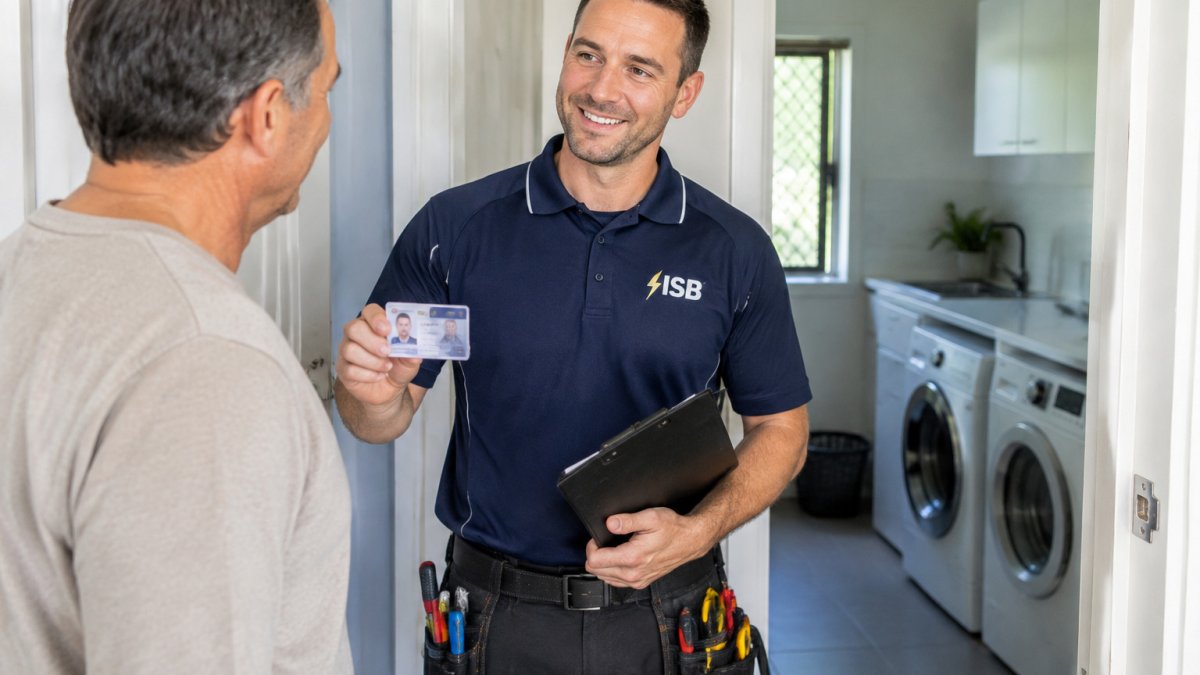
Use this quick checklist:
- Ask for the licence number and check it is current
- Confirm the business holds public liability insurance
- Ask whether the technician is the person who will attend, or a subcontractor
If a company cannot or will not provide these details, treat that as a red flag. For more on what to look for in qualified electrical work, see Are Licensed Electrical Appliance Repairers Worth It?
Step 2: Verify Manufacturer Authorisation and Brand Experience
Appliances are not all built the same. A technician who regularly works on your brand understands its common faults, its service manuals and where to source the correct parts.
Ask these questions:
- Have you repaired this brand and model before?
- Are you authorised by the manufacturer, or trained on their range?
- How often do you see this type of fault?
A common mistake is assuming a general handyman can handle a modern dishwasher or induction cooktop. Newer appliances use electronic control boards that require specific diagnostic knowledge. Choosing a technician with experience on your appliance type saves time and reduces the chance of a repeat visit.
Step 3: Read Reviews and Ask the Right Questions Before Booking
Reviews are useful only if you read them the way an assessor would. A single five-star comment tells you almost nothing; a pattern across twenty reviews tells you how the business behaves when a job goes wrong. Most top-ranking guides stop at "check reviews", this section goes further by showing you what to look for, what to ask before booking, and which answers should stop you proceeding.
How to read reviews for signal, not noise
- Sort by newest first, then read the three- and four-star reviews. Five-star reviews are often left at the point of booking, before the repair has been tested by time. Three-star reviews usually describe the actual experience: punctuality, communication, whether the fault returned.
- Look for repeated phrases across different reviewers. If several people independently mention "arrived late", "quote changed on the day" or "same fault came back", treat that as a pattern rather than a one-off.
- Check whether the business replies to negative reviews. A reply that explains the remedy is a better sign than a reply that argues.
Questions to ask before you book
Use these as a script. A reliable provider will answer them without hesitation; a poor one will deflect, rush, or refuse to put answers in writing.
- What is the call-out or diagnostic fee, and is it credited against the repair if I proceed? Get the figure in dollars, not "it depends".
- What is the arrival window, and will you call if you are running late? A two-hour window is workable; "sometime Tuesday" is not.
- Will you provide a written quote before starting work, and does it separate the diagnostic fee, labour, parts and GST?
- Do you use genuine spare parts, and what is the warranty on parts and on labour? Ask for the duration in months, not "covered".
- Have you repaired this brand and model before, and how often do you see this fault?
- Who will attend, you, an employee, or a subcontractor? If a subcontractor, ask for their licence details too.
- What are your cancellation and rescheduling terms if I need to change the booking?
- Do you service my suburb, and is there a travel surcharge outside your standard area?
- What happens if the fault cannot be reproduced or the repair does not fix it?
- Can you email the quote and warranty terms before I confirm?
Red flags that should stop you booking
- A quote given over the phone without seeing the appliance, presented as final rather than an estimate.
- Pressure to approve work on the spot, or a discount that expires "today only".
- A request for full payment upfront in cash, or payment to a personal account rather than the business.
Watch out: A low call-out fee advertised online is often recovered through inflated parts pricing or a diagnostic fee that is not credited against the repair, ask both questions together so you can compare the true total.
If you are comparing providers, ask each one the ten questions above and compare the written answers side by side rather than the headline call-out fee.
Step 4: Understand Appliance Repair Cost and Call-Out Fees
Most guides tell you to "get a quote" and leave it there. The practical problem is that two quotes for the same fault can look identical on the headline number and differ by hundreds of dollars once you understand what is and is not included. This section breaks down how appliance repair pricing is actually structured, what a written estimate should itemise, and how to compare quotes fairly without relying on a universal price list that does not exist.
The four components of an appliance repair bill
A properly itemised quote separates these, even if it presents a single total at the end:
- Call-out or attendance fee, covers the technician travelling to your home. It may or may not include the diagnostic work.
- Diagnostic fee, the charge for fault-finding: testing the appliance, isolating the failed component, and confirming the cause. Some businesses waive or credit this against the repair if you proceed; others charge it separately and do not credit it.
- Labour, the time to carry out the repair. Ask whether it is charged at a fixed price per job or hourly, and whether there is a minimum charge.
- Parts, the cost of the replacement component, plus any surcharge for genuine versus non-genuine parts. Ask whether the parts price includes GST and whether old parts are returned to you.
A quote that lists only a single figure without these components is not comparable to one that does.
What a written estimate should contain
Before you authorise any work, ask for an estimate in writing that states:
- The appliance make, model and the fault as diagnosed.
- The call-out fee and whether it is credited against the repair.
- The diagnostic fee and whether it is separate from the call-out fee.
If any of these are missing, ask for them to be added before you agree. A provider who will not put the estimate in writing is telling you something useful.
How to compare two quotes without a universal price list
There is no single national price for an appliance repair, and any guide that publishes one is guessing. Instead, compare quotes on structure:
- Compare the credited amount, not the headline fee. A $120 call-out that is credited against the repair is often cheaper overall than an $80 call-out that is not.
- Compare the parts basis. A quote using a genuine part with a 12-month parts warranty is not the same product as a quote using a non-genuine part with a 90-day warranty, even if the totals are close.
- Compare the labour basis. A fixed-price repair removes the risk of a longer job costing more; an hourly rate can be fairer for a simple fault but open-ended for a complex one.
When the repair is not worth the quote
A useful rule of thumb many technicians apply is that a repair costing more than roughly half the price of a comparable new appliance is usually not worth proceeding with, particularly once the appliance is past its expected service life.
Watch out: A verbal estimate that is "about" a figure, with parts and labour left vague, is the most common source of bill shock, insist on the itemised written version before work begins.
For a current quote on your appliance, contact us directly.
Step 5: Confirm the Appliance Repair Warranty in Writing
A warranty is only useful if it is in writing. Ask what the warranty covers, how long it lasts, and whether it applies to both parts and labour.
Check the warranty terms before you pay. For a side-by-side look at what to expect, read Genuine vs Non-Genuine Appliance Spare Parts Compared.
ISB Electrical backs its repairs with a warranty on all spare parts used, and uses genuine spare parts to support long-lasting performance.
Repair or Replace a Faulty Appliance: A Practical Decision Guide
Repair makes sense when the appliance is relatively new, the fault is isolated, and the repair cost is a fraction of replacement. Replacement may be the better choice when the appliance is old, the repair is expensive, or the same parts keep failing.
Use these rules of thumb:
| Situation | Usually better choice |
|---|---|
| Appliance is under 5 years old, single fault | Repair |
| Repair cost is a small share of replacement cost | Repair |
| Appliance is old and has multiple faults | Replace |
| Repair quote is close to the price of a new unit | Replace |
| Safety issue with wiring or heating elements | Repair by a licensed person, then reassess |
For ovens specifically, Is It Worth Repairing Your Oven or Replacing It in 2026? walks through the cost comparison in more detail.
Booking Your Appliance Repair With ISB Electrical
ISB Electrical is a family-owned Gold Coast business led by a qualified Electrical Engineer with over 30 years of experience. We repair washing machines, dishwashers, fridges, ovens, cooktops and dryers, and we use genuine spare parts with a warranty on all parts fitted.
When you book, contact us to discuss your appliance and get a current quote.
Ready to book? Book same-day appliance repair on the Gold Coast with ISB Electrical today.
Frequently Asked Questions
How do I know if an appliance repair service is reliable?
Look for three things: a current electrical or trade licence, public liability insurance, and a written warranty on both parts and labour. Check that the business gives a written quote before work starts and that the technician names the fault they found. Reviews help, but read several across different platforms rather than relying on a single star rating. A reliable provider will answer these questions directly and without pressure.
What should I check before hiring an appliance repair technician?
Confirm the technician's licence and insurance, ask whether they work on your appliance brand, and check that they use genuine replacement parts. Ask how the call-out fee is applied, whether it is credited against the repair, and what warranty applies. Confirm they service your suburb, and ask for a realistic arrival window. Keeping these checks in mind before you book avoids most common problems.
Should I repair or replace a faulty appliance?
Repair is usually the better option when the appliance is fairly new, the fault is a single component such as a thermostat, fan or pump, and the repair cost is well below the price of a comparable replacement. Replacement becomes more sensible when the appliance is old, several parts are failing, or the repair quote approaches the cost of a new unit. Ask the technician to explain the fault and the expected lifespan after repair so you can compare the two options fairly.
Do appliance repairs come with a warranty?
Many reputable repairers offer a warranty on the parts they fit and on their labour, but the period and terms vary between businesses. Ask for the warranty in writing, including what it covers, how long it lasts and what voids it. A warranty on genuine parts is generally more meaningful than one on unbranded components. Keep your invoice, as you will need it if you ever make a warranty claim.